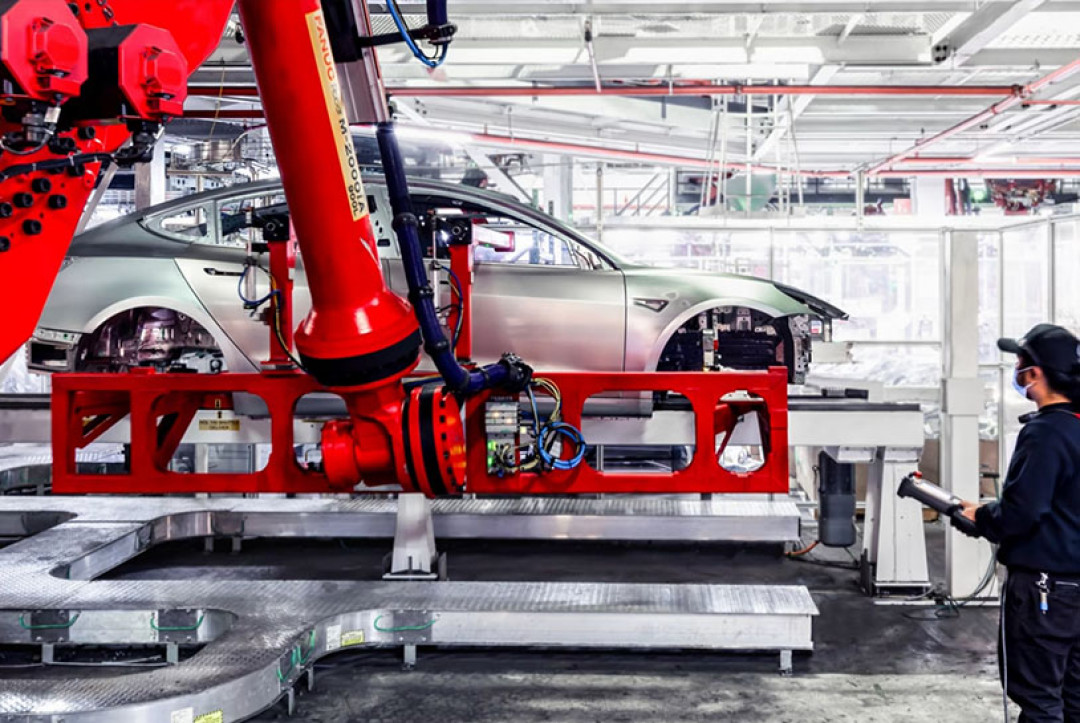

A minor bump – and the expensive car is a total write-off? Critics see precisely this risk with large cast components, such as those used by Tesla, among others: Entire vehicle structures made from a single piece of cast iron could be irreparably damaged even in a minor crash. A new study now gives the all-clear.
By Niklas Reiprich
Large castings are playing an increasingly important role in automobile production. In addition to pioneering Tesla, other major manufacturers are now relying on so-called gigacasting technology. Among others, Volvo is currently installing corresponding facilities in Torslanda, Sweden, to produce large underbody components in a single casting. Toyota also plans to cast entire front and rear underbodies starting in 2026 – starting with its all-electric Lexus LF-ZC sedan. Nissan has even set concrete goals: With gigacasting, the Japanese company aims to reduce its costs by 30 percent and the weight of its next EV generation by 20 percent starting in 2027.

The rear floor pan of the Model Y consists of a single, large cast aluminum part. This model is taken from the service manual, which Tesla makes freely available.
What ensures efficiency in the factory can, however, prove expensive in the event of damage. Even minor accidents raise the question: Can such parts even be repaired economically? Or does a relatively minor impact immediately result in total loss? A component “cast in one piece” sounds promising for production – but less so for maintenance. “If major repairs are necessary, gigacasting is a real problem,” says Wolfram Volk, Professor of Forming Technology and Foundry Engineering at the Technical University of Munich, in an interview with “Die Zeit.” Studies have shown that the basic structure of cars constructed in this way can be so deformed even at low impact speeds that repair at a reasonable cost becomes impossible. “In a side impact, around 15 kilometers per hour is enough for a gigacast component in the immediate deformation area to be irreparable,” says Volk. Just a year ago, it was said that insurers could only offset this by significantly increasing liability premiums – with corresponding costs for car owners.
Proven effects in claims
In fact, the repairability of Gigacast components has been difficult to assess until now due to a lack of realistic data and standardized tests. This prompted the Allianz Center for Technology (AZT) and the British institute Thatcham Research to study the actual impact of large castings on damage. “Currently, only the Tesla Model Y, as a vehicle with a large casting, has a relevant market share, so we chose this design as the basis for our research,” explains Florian Kitzmann, Head of Training and Public Relations at the AZT.
The way the large cast part is integrated into the rear of the Model Y already led the study partners to suspect that damage to it would only occur in high-severity accidents, because it is protected by external, load-bearing structures. High-strength pillars and sills, multi-layer sidewalls, and deformation elements on the bumper cross members could therefore specifically convert the impact energy into deformation.
Repair costs comparable to conventional construction
To determine the relevant accident severity, rear-end crash tests were conducted at Thatcham Research. The tests were designed to determine the threshold of accident severity at which the cast part would be so damaged that it would require replacement. To achieve this, the crash speeds and impact angles were gradually increased or changed to achieve a higher energy input. “The large cast part was only damaged in the crash at a speed of 25 km/h and an oblique impact angle,” reports Kitzmann.
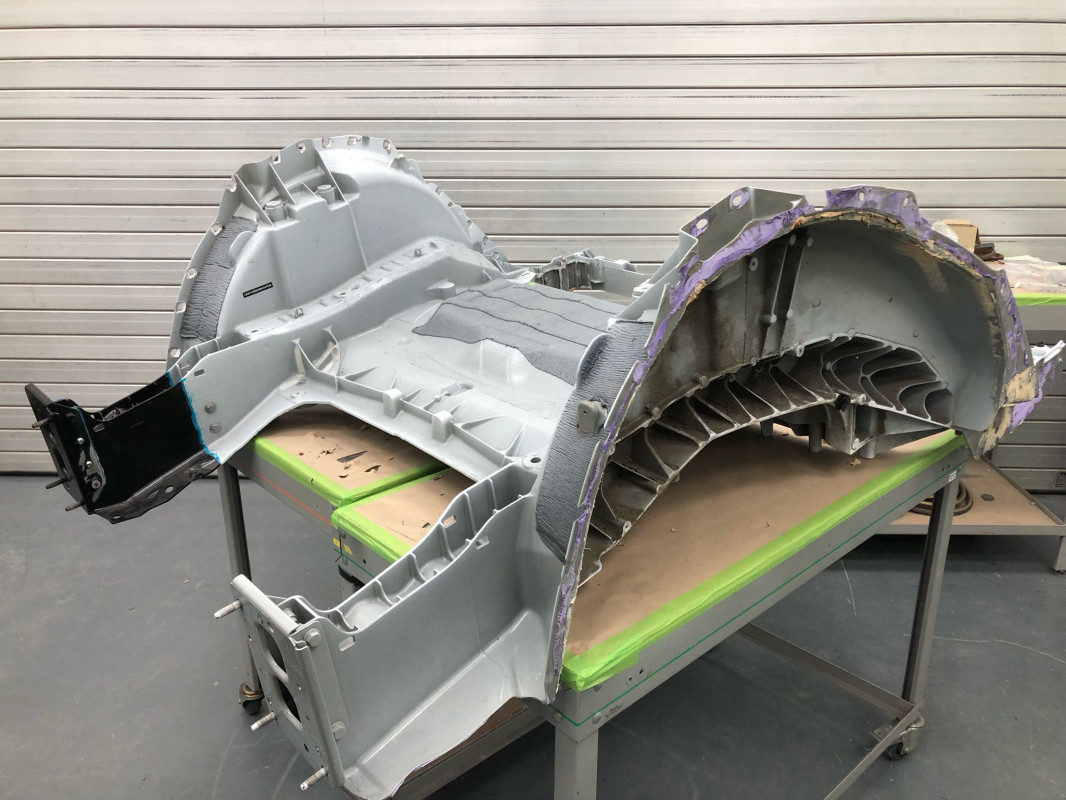
The rear side members in the Model Y consist of modular end pieces that can be replaced individually. Thatcham Research performed this repair after a simulated rear-end damage incident for illustrative purposes.
The crash tests were supplemented by an analysis of real-world accident data: Of the 2,000 evaluated damage cases involving electric vehicles, less than 1.5 percent involved the large cast part, according to the AZT. In these cases, the vehicle was usually so severely damaged that a total write-off would have been unavoidable anyway – regardless of the design. A repair cost comparison by the researchers also revealed that the costs for a typical rear-end damage incident in a Model Y were similar to those in a conventionally built Tesla Model 3 or the VW ID.4.
Tesla itself communicates possible repair procedures surprisingly transparently. The company provides a freely accessible digital service manual online for each model – including the Model Y. This manual contains evaluation criteria that workshops can use to determine whether a large cast part can be repaired or needs to be replaced. If the repair is possible, Tesla guides the customer through the necessary steps. The rear side members, for example, consist of modular end pieces that can be replaced individually. This allows workshops to remove only the damaged section and install a new part using structurally bonded joints. Cost analyses, according to AZT and Thatcham, show that repairs to the Tesla Model Y in the rear and cargo area are comparable to or even cheaper than those for conventionally built vehicles.
Qualification of workshops necessary
If the aluminum casting needs to be repaired by welding, this requires special qualifications and equipment. The material behaves differently than steel, deforms less plastically, cracks more quickly, and can lose its strength due to the heat generated during welding. This requires workshops to focus on targeted training, which will also require investment in new equipment in the future. Large castings in vehicles can be over one to two meters long and incorporate multiple structural areas. This requires larger straightening benches or modular holding systems to precisely secure the parts. Transport and storage are also more challenging in this context – a rear frame for a Model Y, for example, is almost as large as half the floor of a small car.
Kitzmann concludes: “The impact of large castings on insurance claims expenditures can be considered minimal if the casting does not extend to the exterior of the vehicle, if repair solutions are available, and if repair shops are adequately trained.” One relevant characteristic for insurers is the so-called type class, which reflects the damage and accident records of every car model registered in Germany. According to Kitzmann, the type class of the Model Y, as the first vehicle with a significant-sized casting, is “currently not conspicuous.”
Featured image: Tesla
Leave a Reply