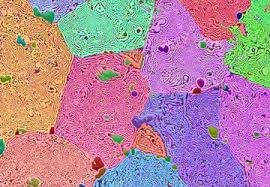
Innovations in metal casting primarily center around High-Entropy Alloys (HEAs), advanced Metal Matrix Composites (MMCs), and high-performance aluminum and titanium superalloys. These materials offer superior strength, heat resistance, and weight reduction.
1. High-Entropy Alloys (HEAs)
Unlike traditional alloys that rely on one base metal (like iron or aluminum), HEAs are formulated by mixing roughly equal amounts of five or more elements (such as iron, cobalt, chromium, nickel, and titanium).
- Benefits: Exceptional thermal stability, superior fracture toughness, and extreme resistance to corrosion and wear.
- Applications: Aerospace components and defense technologies.
2. Advanced Aluminum-Scandium Alloys
These are high-performance aluminum alloys formulated by adding small amounts of scandium.
- Benefits: Dramatically increases yield strength and weldability without adding heavy weight.
- Applications: Electric vehicle (EV) chassis components, aerospace structural parts, and bicycle frames.
3. Metal Matrix Composites (MMCs)
MMCs combine a metal base (such as aluminum, titanium, or copper) with ceramic reinforcements (like silicon carbide fibers).
Benefits: Highly customizable coefficient of thermal expansion, extreme stiffness, and excellent wear resistance.
- Applications: Automotive engine pistons, brake rotors, and aerospace shielding.
4. Advanced Nickel and Cobalt Superalloys
These are engineered specifically to survive environments where regular metals fail, formulated with precise mixes of nickel, cobalt, and titanium.
- Benefits: Unmatched mechanical strength and oxidation resistance at temperatures exceeding 1000°C.
- Applications: Industrial gas turbines and jet engine turbine blades.
5. Liquid & Semi-Solid Metal Casting Advancements
Modern foundries are optimizing how traditional and new alloys are poured to avoid defects.
- Gas-Induced Semi-Solid (GISS) and New Rheocasting (NRC): Involves using inert gas or controlled cooling to create a semi-solid slurry before casting, minimizing shrinkage and micro-porosity.
Leave a Reply